1) How would you define atheism?
Answer:
2) Do you act according to what you believe (there is no God) in or what you don't believe in (lack belief in God)?
Answer: Of course I act like there is no god. Please note the question is poorly formed as it strongly implies all atheists believe god doesn't exist. Most simply don't believe the god claim.
3) Do you think it is inconsistent for someone who "lacks belief" in God to work against God's existence by attempting to show that God doesn't exist?
Answer: Not at all. It's really the various fan clubs of the gods that atheists are working against by showing god doesn't exist.
4) How sure are you that your atheism properly represents reality?
Answer: Very. Nothing logical or empirical to support theism, lots of logical & empirical to support atheism. The probability of atheism being true is so much higher than theism it seems like a safe bet. Like betting the Yankees will beat a Little League team.
5) How sure are you that your atheism is correct?
Answer: See #4.
6) How would you define what truth is?
Answer:
7) Why do you believe your atheism is a justifiable position to hold?
Answer: See # 4
8) Are you a materialist or a physicalist or what?
Answer: First I'd suggest using citations from outside your own website:
To answer, these positions are so similar & are often used interchangeably. I currently hold to both positions but if convincing evidence were provided to show them to be false, I would change my mind without issue.
9) Do you affirm or deny that atheism is a worldview? Why or why not?
Answer: Deny. Atheism is a view on one subject only…gods existence. While my atheism does affect my worldview, it is not, in itself, a worldview.
10) Not all atheists are antagonistic to Christianity but for those of you who are, why the antagonism?
Answer: The antagonistic ones are typically also anti-theists. Don't conflate the 2 positions.
In my experience, they/we are antagonistic in response to what they/we see as hypocritical & harmful behaviour from Religious people (it's not just Christians). It's like asking why a Civil Rights protestor is antagonistic to a racist.
11) If you were at one times a believer in the Christian God, what caused you to deny his existence?
Answer: I was raised in a Christian home, but I'd be hard-pressed to ever say I was a Christian. From the age of reason onward I have questioned the validity of Christianity. At best, I was once a deist, or perhaps the catch all, new-agey "Spiritual, not Religious" view that I now see as just a "moving the goal posts fallacy.
12) Do you believe the world would be better off without religion?
Answer: In general yes. Would the world be perfect? No. Humans, as a race, are assholes & have many reasons beyond religion to kill each other over. Removing Religion would however, remove one of the biggest reasons. No, I don't support banning religion.
13) Do you believe the world would be better off without Christianity?
Answer: See # 12.
14) Do you believe that faith in a God or gods is a mental disorder?
Answer: No. Although many are indoctrinated or brainwashed to believe & that is a form of mental disorder.
15) Must God be known through the scientific method?
Answer: The scientific method is currently the best method we have for validating a hypothesis & "god" is just another hypothesis in my opinion.
16) If you answered yes to the previous question, then how do you avoid a category mistake by requiring material evidence for an immaterial God?
Answer: I don't see this as a mistake. See # 8. There is no reason to believe anything immaterial exists beyond the claims of theists.
17) Do we have any purpose as human beings?
Answer: Your purpose is what you make of it.
18) If we do have purpose, can you as an atheist please explain how that purpose is determined?
Answer: My purpose has been different at various points of my life. Currently it is trying to raise my 4 amazing children to be good people with or without a god in their lives. It'll be their choice, especially since their mom, my fantastic wife, is Catholic.
19) Where does morality come from?
Answer: Empathy & social evolution.
20) Are there moral absolutes?
Answer: Yes
21) If there are moral absolutes, could you list a few of them?
Answer:
- Don't cause suffering.
- Reduce suffering whenever possible
Some specifics:
- Don't murder.
- Don't rape.
- Humans are not possessions (No slavery)
22) Do you believe there is such a thing as evil? If so, what is it?
Answer: Not in the supernatural sense but in the poetic. Murder, rape, slavery, for example, are "evil". Intentionally causing suffering for malicious reasons.
23) If you believe that the God of the Old Testament is morally bad, by what standard do you judge that he is bad?
Answer: The god of the OT doesn't exist. The fictional character of Yahweh, described in the OT is "morally bad". See # 22; Yahweh does not object to slavery & is exceptionally soft on rape. Genocide seems acceptable to him as well (See the Great Flood, plus commandments to kill all men, women & children of rival tribes.
24) What would it take for you to believe in God?
Answer: Evidence. I still wouldn't worship if it turned out to be Yahweh/Allah.
See also http://atheisteh.blogspot.com/2014/08/threshold-of-proof.html
25) What would constitute sufficient evidence for God’s existence?
Answer:
- Perhaps if he'd stamped his name on our DNA like humans did when we created artificial DNA.
- Clear, undeniable & well documented miracles.
- Show himself.
- If the Aztecs had been found to have essentially the same beliefs as the Judeo-Christian's it would have gone a long way in proving Yahweh. Why wouldn't he reveal himself to more than one small tribe in the Middle East?
26) Must this evidence be rationally based, archaeological, testable in a lab, etc., or what?
Answer: Yes. Why would I believe irrational, non testable, non falsifiable evidence? There's a word for that…faith.
27) Do you think that a society that is run by Christians or atheists would be safer? Why?
Answer: Atheists come in all types, good & bad, as it's not a worldview (See #6), so a society run by
Secular Humanist atheists would be best. We've seen what societies run by Christians look like, I think it's worth seeing if Secular Humanists could do a better job.
28) Do you believe in free will? (free will being the ability to make choices without coercion).
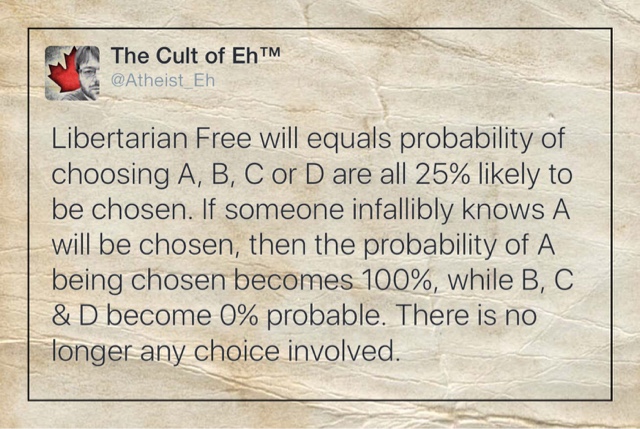
Answer: I believe we have, as a minimum, the illusion of free will. Whether we actually do, is a debatable subject.
29) If you believe in free will, do you see any problem with defending the idea that the physical brain, which is limited and subject to the neuro-chemical laws of the brain, can still produce free will choices?
Answer: This is exactly why freewill is a debatable topic.
30) If you affirm evolution and that the universe will continue to expand forever, then do you think it is probable that given enough time, brains would evolve to the point of exceeding mere physical limitations and become free of the physical and temporal and thereby become "deity" and not be restricted by space and time? If not, why not?
Answer: It's impossible to predict where evolution will take humanity. However, since we've never seen anything be free of the physical or temporal, there is no reason to think humans will ever evolve past them.
31) If you answered the previous question in the affirmative, then aren't you saying that it is probable that some sort of God exist?
Answer: I didn't answer yes, but let's pretend I did for the sake of argument. Simply being free of the physical & temporal would not make us deities, just different than we are now.
Even still, admitting that some kind of deity may exist, does not automatically mean that the Judeo-Christian god exists or might possibly exist. The Judeo-Christian god has very specific properties, attributes, character traits & stories attributed to it in the bible which can be used to show exactly why the Judeo-Christian god does not exist.
Too many theists have tried to adopt the arguments of a Deist & it just doesn't work.